By Wells Winegar, Executive Director, New Jersey Policy Institute
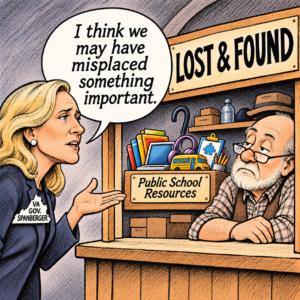
On Friday, the Washington Post reported that Governor Abigail Spanberger will not finish enrolling Virginia in the Federal Education Tax Credit. Her office’s explanation: the administration “does not believe this program would benefit students in public schools.”
That’s not just disappointing. It’s wrong, and Virginia’s public school kids will pay for it.
Both states’ kids need the help
On the Nation’s Report Card (NAEP, 2024), only 31% of Virginia 4th graders and 29% of 8th graders were proficient in reading, and just 29% of Virginia 8th graders were proficient in math. New Jersey does better, but not by much: 38% of our 4th and 8th graders are proficient readers, and only 37% of 8th graders are proficient in math, down from 44% in 2019. In both states, most kids are not where they need to be. That’s exactly who high-impact tutoring is built for.
Public school students are in the program by design
The credit lets taxpayers redirect up to $1,700 of what they already owe the IRS ($3,400 for married couples) to a Scholarship Granting Organization. Any student eligible to attend public school, from a household earning up to 300% of area median income, qualifies. That’s the vast majority of families. Scholarships can pay for tutoring, special needs services, books and technology, not just tuition. And not a dollar comes from a state budget, a school funding formula or a property tax bill.
Opting out doesn’t stop the money. It sends it away.
Virginians can still claim the full credit. Their donations will just fund kids in other states. Democrats for Education Reform estimated that 15% participation would generate about $766 million for Virginia. Now none of it can reach the Commonwealth’s 1.25 million public school students. At least one local effort, a tutoring fund built for high-poverty public schools, has already been stopped in its tracks.
Democratic governors who said yes saw the opportunity
Colorado’s Jared Polis called it a “real boom of investment in kids.” New York’s Kathy Hochul opted in over union objections, saying she wasn’t “going to leave money on the table when it could help our kids.” New Mexico’s Michelle Lujan Grisham followed this month. Each saw new private dollars, at no cost to their state, that public school families could use.
New Jersey can prove the public school case
NJPI isn’t just arguing that point. We’re building it. This week, NJPI and ACE Scholarships launched the NJ Teachers Public School Tutoring Fund, an SGO that pays New Jersey public school teachers to give New Jersey public school students high-impact tutoring. ACE has more than 25 years of experience and 135,000+ scholarships behind it, and will manage every gift and award. Our first teacher ambassador is Rhiannon Mindas, a New Jersey public school teacher.
That’s the direct answer to Virginia’s concern. But the fund can only serve New Jersey kids if New Jersey opts in.
Donors can learn more and commit at njpublicschoolsgo.com.
See what’s at stake in your town
NJPI’s Cost of Staying Out Calculator estimates the scholarship dollars available by town, school district and legislative district. Statewide, based on a 10% participation rate, we estimate New Jersey would forfeit about over $1.5 billion over the program’s first three years if it stays out.
Governor Sherrill, don’t follow Virginia
Governor Sherrill has until December 31 to decide. New Jerseyans will be eligible for this credit either way. The only question is whether their generosity pays for tutoring in Newark, Camden and Paterson, or in other states.
Virginia left its money unclaimed. New Jersey should keep ours home.