by Megan Whitman, NJPI Jr. Fellow
June 27, 2026
New Jersey’s 2027 budget went into effect in the beginning of July, totaling appropriations of $60.74 billion. Although taxes were not raised with this budget, they were not lowered either, meaning New Jersey will firmly remain for another year as the second worst state in the nation for tax competitiveness.
Although the state’s tax rate is unchanged in this year’s budget, its effect on taxpayers is bringing significant change. This year, numerous corporations have announced their exit from New Jersey. Big-name corporations like Samsung and ExxonMobil have announced their plans to move out of the state by the end of the year. Focus NJ estimates that these moves will cause New Jersey to lose 7,000 jobs, $675 million in annual payroll, and nearly $55 million in state taxes.
These announcements should not come as a surprise. The exit of big corporations like Samsung and ExxonMobil may make the news, but they are just two of the thousands of businesses, big and small, that are leaving the state or closing down. The reason for this lies partially in the state’s taxes, namely, the corporate business tax.
According to a 2026 survey done by the Tax Foundation, New Jersey has the highest corporate business tax rate in the entire country. New Jersey has a graduated corporate tax rate, meaning businesses pay a higher or lower tax depending on their net income. For businesses who have a net income of $50,000 or less, the tax is 6.5%. A net income greater than $50,000 and less than or equal to $100,000 incur 7.5%, and a net income greater than $100,000 incur a 9% tax. There is also an additional 2.5% surcharge on businesses who make over $10 million. Why would Samsung pay 11.5% in taxes each year when they could pay 0.75% in Texas? Why would any business want to spend the time figuring out where it falls in New Jersey’s graduated tax rate when it could pay a single flat rate in 30 other states?
New Jersey is also uncompetitive for the northeast. The chart below lays out the corporate taxes for northeastern states, and New Jersey’s maximum tax rate outdoes every other state in the region by at least 2%.
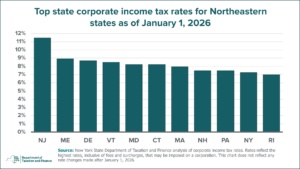
While New York’s corporate tax rate of 6.5% and 7.25% is numerically similar to New Jersey’s own 6.5% and 7.5%, the number of businesses being taxed at each rate is much different. New York’s 7.25% rate is only for businesses who make more than $5 million, while New Jersey taxes a rate of 7.5% for businesses with an income between $50,000 and $100,000. New Jersey’s rate shifts a greater tax burden on smaller, more financially vulnerable businesses, while New York makes more of an effort to place the higher tax on businesses who can more securely afford to pay it.
With the current trend of businesses leaving, New Jersey needs policies that will transform the state into one that is business-friendly and regionally competitive. A difficult, but much-needed, step would be to alter the corporate tax rate in New Jersey. New Jersey could consider adopting a New York-style approach and raise the graduated base levels to a higher income level. For example, the 9% corporate tax rate currently levied on businesses who have a net income greater than $100,000 could be changed to only be levied on businesses who have a net income of $1 million or greater.
Alternatively, New Jersey could consider lowering the overall corporate tax rate. Pennsylvania has proven this can be done, having enacted legislation that will take their corporate tax rate from 9.99% to 4.99% by 2031. Some New Jersey legislators have already taken to trying to introduce legislation to do this. Bill A2654 is currently pending, pledging to gradually reduce the corporate tax rate to a flat 2.5%. Unfortunately, legislation like this has been circulating for years, having as much movement as the tax rates in the newest budget.
The steady trickle of businesses leaving the state despite the stagnation of the tax rate shows that stability is not always the solution. Regardless of the many directions change to the corporate tax could take, one thing is without doubt: change needs to happen.